The Future of AI Wearables: Beyond the Humane AI Pin

The Dawn of a New Era in Wearable Technology
The wearable technology landscape is undergoing a seismic shift. For years, smartwatches and fitness trackers dominated our wrists, offering notifications and health metrics. However, the introduction of devices like the Humane AI Pin and the Rabbit R1 signaled a bold departure from screen-centric interactions. These early iterations of AI wearables promised a future where technology seamlessly integrates into our daily lives, acting as an ambient assistant rather than a demanding distraction. Yet, as we navigate through 2026, it is clear that the Humane AI Pin was merely the prologue to a much larger narrative.
The initial reception of the Humane AI Pin was a mix of awe and skepticism. While the concept of a screenless, voice-first interface was revolutionary, the execution left much to be desired. Issues with latency, battery life, and the awkwardness of public voice commands highlighted the limitations of first-generation AI hardware. But the tech industry is nothing if not resilient. Learning from these early missteps, a new wave of AI wearables is emerging, promising to deliver on the lofty expectations set by their predecessors.
Beyond the Pin: The Evolution of Form Factors
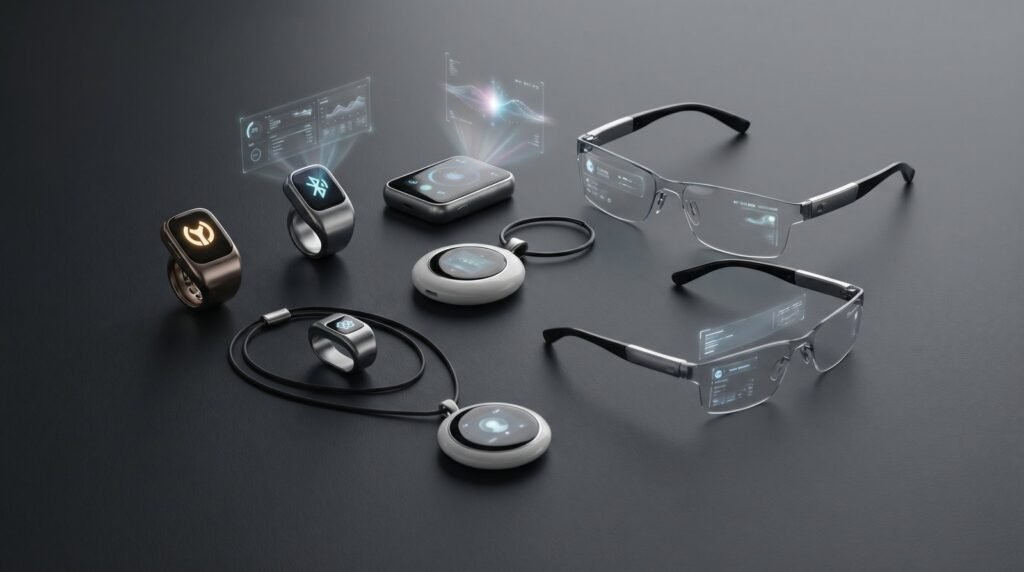
One of the most significant developments in the AI wearable space is the diversification of form factors. The pin, while unobtrusive, proved to be less than ideal for many users. Today, we are seeing AI integrated into a variety of everyday items, from smart glasses to intelligent rings and even smart fabrics.
Smart Glasses: The Clear Winner
Smart glasses have emerged as the frontrunner in the AI wearable race. Companies like Meta, in collaboration with EssilorLuxottica, have refined the Ray-Ban Meta smart glasses, transforming them from a novelty into an indispensable tool. The integration of advanced multimodal AI allows these glasses to not only hear and speak but also see and understand the user’s environment. Imagine walking through a foreign city and having your glasses translate signs in real-time, or looking at a broken appliance and receiving step-by-step repair instructions overlaid in your field of vision. This seamless blending of the digital and physical worlds is what makes smart glasses so compelling.
Intelligent Rings and Hearables
For those who prefer a more discreet approach, intelligent rings and advanced hearables are gaining traction. Devices like the Oura Ring have evolved beyond simple health tracking, incorporating AI to provide personalized insights and proactive health management. Meanwhile, hearables are becoming true in-ear assistants. With advancements in bone conduction and noise cancellation, these devices can isolate the user’s voice even in crowded environments, making voice commands more reliable and less socially awkward.
The Power of Contextual AI
The true magic of the next generation of AI wearables lies not just in their hardware, but in their software. The shift from reactive to proactive AI is redefining how we interact with technology. Early AI assistants required explicit commands to perform tasks. Today’s contextual AI anticipates our needs based on a myriad of data points, including location, time of day, biometric data, and past behavior.
For instance, an AI wearable in 2026 doesn’t just tell you the weather when asked; it proactively suggests you take an umbrella because it knows you have an outdoor meeting scheduled in an hour and the forecast predicts rain. It monitors your stress levels through your smart ring and suggests a brief breathing exercise when it detects a spike. This level of personalization and anticipation transforms the wearable from a mere tool into a true companion.
Privacy and Security in the Age of Ambient Computing
As AI wearables become more integrated into our lives, the amount of personal data they collect grows exponentially. This raises significant concerns regarding privacy and security. The industry has recognized that for AI wearables to achieve mass adoption, users must trust that their data is safe.
To address these concerns, manufacturers are increasingly adopting edge computing. By processing data locally on the device rather than sending it to the cloud, wearables can offer faster response times and enhanced privacy. Furthermore, robust encryption and transparent data policies are becoming standard features. Users now have granular control over what data is collected and how it is used, ensuring that the convenience of AI does not come at the cost of personal privacy.
The Future is Seamless
The journey from the Humane AI Pin to the sophisticated wearables of 2026 has been marked by rapid innovation and a deeper understanding of human-computer interaction. We are moving away from a world where we must constantly look down at our screens, toward a future where technology is woven into the fabric of our lives. The next generation of AI wearables promises to empower us, providing the information and assistance we need, exactly when we need it, without demanding our undivided attention.
As we look ahead, the possibilities are boundless. From AI-enhanced prosthetics to smart clothing that adjusts to our body temperature, the intersection of AI and wearable technology will continue to push the boundaries of what is possible. The Humane AI Pin may have been the spark, but the fire it ignited is illuminating a future where technology truly serves humanity.



 English
 简体中文
简体中文 繁體中文
繁體中文 日本語
日本語
Responses